
In my first year at Agnes Scott College, I was looking for my major and taking any class I found interesting. For this course, I played to my past strengths in high school as an International Baccalaureate student studying American and European history and enrolled in History 207: The Global Middle East. I had never taken a history course outside of Europe, the Americas or Asia, realizing that college is the place to push myself to widen my lens.
The course is described as follows: “The proliferation of commodities, ideas, and peoples throughout the globe during the late nineteenth and early twentieth centuries has led to the rise of global studies. This course explores themes in the modern Middle East in light of this “global” turn. The first three weeks will provide a theoretical background on the questions that inform the course. The discussion will start with an overview of the study of nationalism in the Middle East. It will then proceed to a discussion of approaches that question using the “national” as a lens to study the history of the modern Middle East. Students will learn about such concepts as as “transnationalism,” “internationalism,” and “globalization.” The rest of the course will then explore various themes from the late nineteenth century to the present. This includes: the rise of the world economy, imperialism, the first wave of globalization, World War I and internationalism, diasporas and transnationalism, the global Cold War, oil, the “Global War on Terror.” Finally, students will also be asked to think about the recent Arab uprisings and the merits of using transnationalism as a point of inquiry in the history of the Middle East.”
We capped off the semester by creating a digital page about a research topic. For my project, I studied late nineteenth century transatlantic Ottoman-Syrian migration. During the course we had largely focused on Ottoman history, but I was curious about the more recent history of displacement and migration from the Middle East. In 2018, I had just moved from the Netherlands, where I had volunteered with Syrian refugee communities resettling throughout Europe, and I wanted to understand where Syrian communities already existed globally before the refugee crisis. In this project I learned about a transatlantic movement of people predating modern crises, and wondered at the use of deterrence instead of assistance to refugees, illustrated by the ‘Ferries not Frontex‘ image.

Image of the Ottoman flag, designed during the Tanzimat (‘reorganization’ in Turkish) period, which lasted from 1839 to 1876 (Mysid). Establishing an Ottoman flag emulated ‘enlightened’ European nation-states (“Tanzimat”).
Introduction
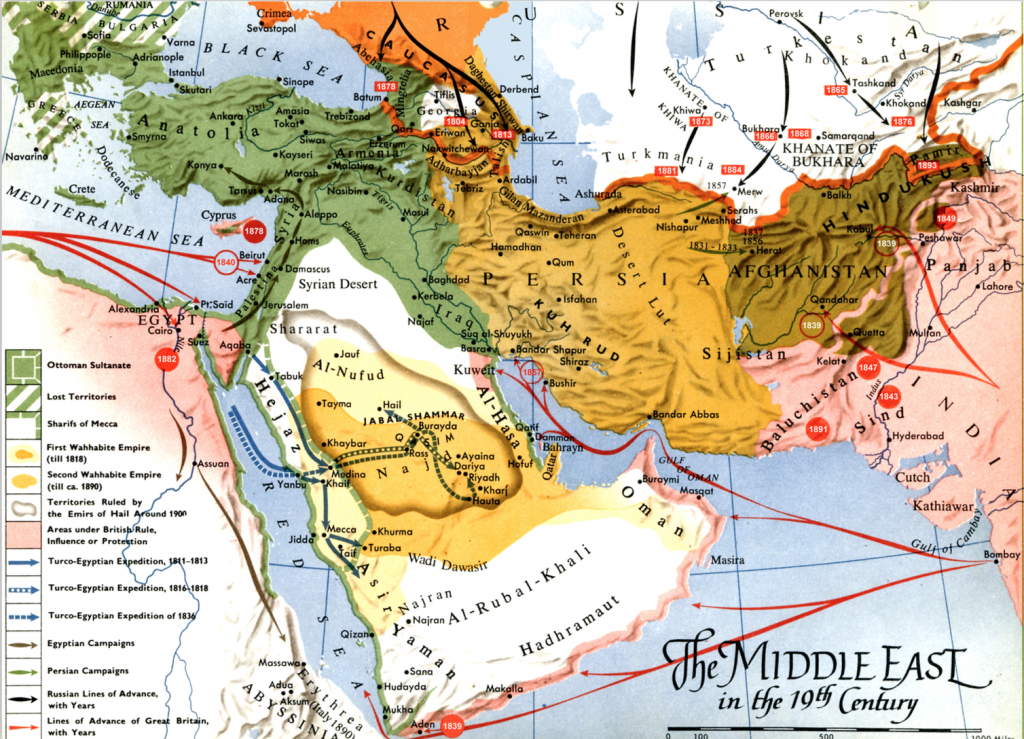
A map of the Middle East, including the Ottoman Empire in the nineteenth century (Center for Middle Eastern Studies). From the end of the Tanzimat in 1876 until the turn of the century, the Empire was composed of areas in the Fertile Crescent, Anatolia, the Levant, the southeastern Balkan region, north Africa and the Arabian Peninsula (“Empire from 1807 to 1920”).
In the late nineteenth century, there were two major movements of people in the Ottoman Empire: displaced, mainly Muslim, people immigrating after the Ottoman-Russian wars and Ottomans emigrating from the Empire to Egypt and the Americas (Karpat). Most emigrants left Ottoman provinces in Greater Syria, which included areas of modern Lebanon, Turkey, Jordan, Israel and Palestine (Kayal). This digital exhibit focuses on the ‘First Wave’ of Greater Syria emigrants, and argues that they were primarily economic aspirants, who left the Ottoman Empire because of globalization processes and for a myriad of personal reasons.
Causes of Ottoman Emigration
For the majority of the six hundred year Ottoman period, during rapid geographical expansion, Ottoman imperialism relied upon integrating newly incorporated populations through migration. As Ottoman expansion slowed into the nineteenth century, Europe surpassed the Ottoman Empire through industrialization, and Ottomans interacted with the West through technological globalization and investing in the Europe-led capitalist world economy (“Ottoman Empire in the Nineteenth Century”). As a result, more Ottoman peoples had contact with the West, and viewed it favorably as an economic option.
“‘You can make money here”—that was the message America flashed across the seas to Syria.”
Individual Muslim migration to the Americas has likely occurred since the first African slaves before the American Revolutionary War (Orfalea). After 1876 however, a greater influx of migrants began from Greater Syria, ultimately totalling to half a million people, mostly Christian, some Muslim, Druze and Jew by the end of the major Ottoman migratory period and the First World War. First Ottomans left to Egypt and then to the Americas, including the U.S., some immigrating and others eventually returning.
Economic globalization is not a historical term, but combining economic trends and globalization processes summarizes this major cause of Ottoman emigration.
In the traditional Ottoman economy, prices and quantity remained unchanged in the interior, upheld through a system of agricultural and domestic peasants and slaves (“Rise of the World System”). Following the Industrial Revolution, the Empire integrated into the European-led, capitalist world economy. Deals with European countries, like the British-Ottoman trade edicts gave foreign merchants favorable trade deals, hurting the profits and success of Ottoman merchants (Toledano). Through this, Ottomans became dependent on Western markets to determine their production. Peasants, investing in cash crops like silk, were exposed to the fluctuations and pitfalls of the world economy. As a result, peasants were economically dislocated and willing to migrate further than before (to Arabic-speaking countries like Egypt) in order to provide for themselves and their families.
For example, Mount Lebanon peasants invested deeply in the silk industry during the 1840’s silk boom, due to French demand and desire for Lebanon silk (Khater and Khater). When the silk industry collapsed in 1877 and 1889, due to mechanization, silkworm and mulberry leaf disease and quality control issues, peasants especially were dislocated from the economy. Peasants took devastating losses, Chinese silk grew popular and domestic tastes turned to European goods (Shakir). The Lebanese silk economy crashed and sericulture was no longer viable. In addition to the silk collapse, the construction of the Suez Canal contributed to economic dislocation, as ships were rerouted away from the coasts of Greater Syria, and sectors apart from the silk industry experienced similar downturns (Orfalea). Thus, the earliest Syrian migrants came from the lowest socioeconomic classes.
The technological modernizations of globalization altered the social structure of the Ottoman Empire, leading to religious questions about Ottoman interaction with the West. The modernizations of transport, steamships and railways, communication and telegraphs, and information about the outside world flowed from port cities, European travelers, merchants and later missionaries. Ottomans had increased familiarization with external cultures.
Fast-paced urban areas like port cities were an attractive alternative for ambitious and employment seeking individuals. Beirut, close to Mount Lebanon, was a “gateway” for the trade of goods and ideas (Shakir). In the face of new technologies, new employments, such as telegraph operators and other professions expanded, while old craftsmen dwindled.
The ability to return and communicate from far away allowed migrants to galvanize relatives from to migrate. These “shifting political and economic dynamics, and more readily available transportation, permitted ambitious migrants to transfer their destinations from the nearest urban centers within the region to those throughout Europe and across the Atlantic” (Naar). The majority of migrants came from Mount Lebanon, and Greater Syria with closer access to portside transportation than more interior Ottomans.
In addition, Westerners were regular visitors to the Arab world. Artists, diplomats, merchants, pilgrims, scholars, archaeologists and missionaries all came to the Ottoman Empire. In 1866, the Syrian Protestant College (later the American University of Beirut) was established, forming a center for missionaries and Western academics (Shakir). U.S. missionaries established elementary schools, and because of their popularity, later local schools were modeled after them (Orfalea). Though they may not have overtly pushed emigration, their presence and curriculum introduced U.S. as a viable option.
Technological advancements were also shown on a global scale in American expositions during the end of the nineteenth century (Shakir). The 1876 Centennial Exposition in Philadelphia brought a large delegation of Ottomans, and “some of the first Ottoman Jews on American soil… explicitly as representatives of the sultan” (Naar). Later Syrian-Palestinian merchants spread word from cities to countrysides of success upon return to the Empire. These first arrivals left without a route to follow, but later in the 1890s, technology and transport, alongside growing demand created a network from steamships to hotel keepers to transport migrants across the Atlantic (Shakir).
Also, Ottomans brought their wares and technologies to the Americas too. A large Ottoman delegation “arrived in St. Louis for the World’s Fair in 1904.” At the Columbians Exhibition in Chicago in 1893, with Jews “constituting four-fifths of the Ottoman entourage…[they] served as unofficial Ottoman ambassadors to the United States and performed as Ottomans on Chicago’s world stage” (Naar).
From 1839 to 1876, and heavily in the 1870s, the Ottoman Empire underwent a series of imperial Tanzimat reforms. Through focusing on its citizens’ equality and rights as a method to centralize, an intelligentsia and middle class formed by the late nineteenth century. An Ottoman identity was developed through administration, creating “Ottoman ‘citizens’ by redefining the relationship between millets (ethno-religious groups) and the state” (Naar).
After the 1860 Civil War, Mount Lebanon was granted more autonomy and its people were free from conscription, able to interact with foreigners to build infrastructure (Shakir). Mount Lebanon, and Greater Syria people were more able to leave the Empire.
While some modernizations did stabilize populations, and grant some autonomy, centralization flared domestic tensions.As the Empire centralized after the European nation state model, reformers and political opportunists left and organized based on their ideologies outside of the Empire, in khedivate Egypt or further away (Orfalea).
The Tanzimat reforms in land ownership, taxation, a school system, religious equality created a new middle class, and despite intentions to equalize, European associated business people held more privileges, and were not subject to Ottoman law. This caused economic tension, which became religious concerns. Whereas peasant and lower social classes were the first migrants, increasingly upper class people, with formal educations, professional and academic knowledge, migrated from the Ottoman Empire. Additionally, the aforementioned technologies brought ideologies, socialism, nationalism, secularization, which spread in the Empire as religious leaders contended with the potential impact of the West.
According to writer Gregory Orfalea, migrants to the U.S. also became journalists, now able to practice their profession more freely than under Ottoman censorship and politicians. As Dr. Arbeely described in American journalism, he brought his family to America because he “desired freedom of speech and action and education advantages for my children,” and wished to escape “retrograding civilization and a tyrannical government” (Orfalea). Historian Reem Bailony posits this reasoning as a common trope among early Arabic-speaking migrants, but most migrants did not leave because of persecution, or consider the Ottomans tyrants.
Some historians maintain that the Mount Lebanon Civil War, between the Christian Maronite church and the Druze, an Islamic sect, was a primary cause for migration. Other historians argue that the War was caused by political manipulation of pre-existing tensions and religious sects.
The facts are that the rebellion of peasants against the landowning class spiralled, with killings targeting Christian peasants and Druze landowners, eventually totalling at least five thousand deaths (Khater and Khater). The fighting spread as far as Damascus, claiming twenty thousand Christian victims there (Orfalea). But how many victims or refugees left the fighting to emigrate?
The heralded first Syrian family to America, of Dr. Joseph Awad Arbeely, an Arbeen, Syria native, was cited by American press as having left “intercenine warfare” to come for “freedom and opportunity” (Orfalea). Arbeely had fled to Beirut from Arbeen in 1860, but left to the U.S. eighteen years later. According to historian Devin Naar, “Christian populations actively sought to liberate themselves from Ottoman rule” (Naar). Historian Evelyn Shakir agrees that,“Most who came—90 percent of more—were Christian, a statistic that has been accounted for in various ways” (Shakir).
Indeed, early migrants registered in the United States as ‘Turks’ as their race and not citizenship, until the classification of ‘Syrian’ was introduced in 1899 (Naar). In the Ottoman Empire, due to the aforementioned Tanzimat reforms, all “Jewish, Christian, and Muslim ‘citizens’ of the Ottoman Empire were to qualify under the rubric of Turkinos” (Naar). Reforms of the Tanzimat, the red flag with a white crescent and star, the citizenship rights and equality, were all to assimilate diverse peoples composing the Ottoman Empire into a administrated monolith. To its detriment, it means that in the Americas, people’s origins were labelled altogether and inaccurately.
In contrast, some Ottoman Jews willingly espoused the ideology of “Ottomanism” (Naar). Historian Devin Naar established that “The ‘one or two detached individuals’ who ‘drifted over’… prior to the Young Turk Revolution included a group of Jewish merchants who arrived first and foremost as ‘Ottomans’,” they were proud of their Ottomanism (Naar).
However, some may have wanted to obscure their origin, or to self-determine upon arrival in the Americas. There has been pervasive islamophobia in the Americas, and this may have influenced Muslim people to claim Christianity (Kayal). Some Jewish people also obscured their origins, making “differing claims about their nationality, country of origin, citizenship, or race in order to evade immigration quotas or gain employment in their new land of residence” (Naar). Jews and Muslims both faced antagonism and discrimination when emigrating to the Americas. In Greater Syria, religion “divided the Middle Easterner into two generally antagonistic camps: Christian and Moslem,” with Christians further subdivided and antagonistic (Naar).
According to some historians, the choice to migrate came down to whether people could afford overseas passage, or had felt some “kinship” with American missionaries, or had interacted with overseas merchants (Orfalea). The narrative of religious persecution can be called into question if only because there are not reliable statistics, and migration to nearby locales was common. According to historian Philip Kayal, “nearly ninety percent of all Arabic-speaking immigrants arriving here before 1924 were Syrian Christians from Mount Lebanon,” either Roman Catholics or Eastern Orthodox, “Arab only in culture” (Kayal). Mount Lebanon’s massacres may have been cause for few, but probably not for the majority of transatlantic migrations.
Timeline of Migration Causes
- 1839 - Tanzimat reforms begin
- 1840s - Silk industry boom
- 1850s - Steamships globalized
- 1855 - Ottoman telegraphs established
- 1860 - Mount Lebanon Civil War
- 1860 - First Ottoman railway built
- 1861 - U.S. Civil War begins
- 1861 - Mount Lebanon autonomous with ‘Mutasarrif’
- 1865 - U.S. Civil War ends
- 1867 - Egypt becomes ‘Khedivate’
- 1869 - Suez Canal built
- 1870 - 1871 Franco-Prussian War
- 1872 - Anatolian railway built
- 1876 - Tanzimat reforms end - Constitutional period begins
- 1876 - Philadelphia Centennial Exposition
- 1877 - First silk industry collapse
- 1877 - 1878 Russo-Turkish war
- 1878 - First Arab (Arbeely) family in U.S.
- 1882 - British occupation of Egypt begins
- 1889 - Second silk industry collapse
- 1893 - Chicago World’s Fair
This timeline of events lays out key dates related to Ottoman migration to the Americas due to economic globalization, technological revolution, the reform movement, domestic conflict and chain migration. As the silk market crashed, migrants left to Beirut, France, West Africa, New York, Beirut and Argentina (Khater and Khater). For example, peasant Assaf Khater was born to a two hundred year long peasant line in the midst of the silk recession. Khater, seeking employment, left to Uruguay and became a peddler and trader, working his way up to own a shop and eventually returned to Mount Lebanon. His life, albeit a singularly successful example of peasant social mobility, is an example of a family member going ahead to work before sending for the rest of their family. Dislocated Ottoman workers often left to be peddlers and textile merchants in frontier societies like the U.S. These migrants, moving for economic reasons, often headed to South America, where agricultural enterprises beckoned (Khater and Khater). First migrants usually did not “intend to stay,” just to make money and return, but as more success came back, more left in search of the same (Shakir). As is shown by the timeline, multiple factors including historical events, culminated in the First Wave of migrants moving at the end of the nineteenth century.
Conflicting Historiographies: The Where and When of Migration
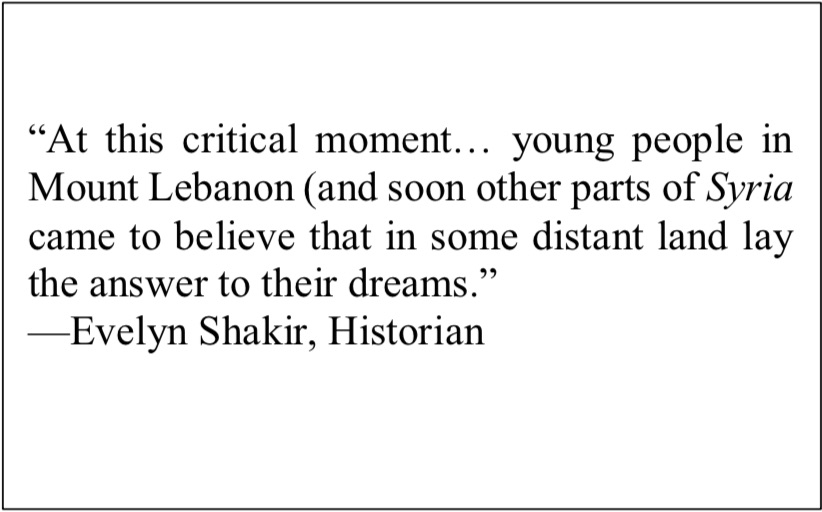
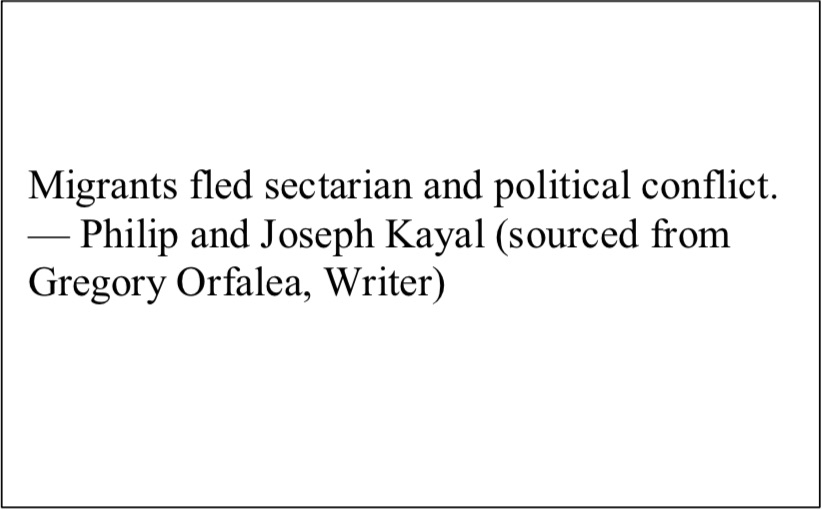
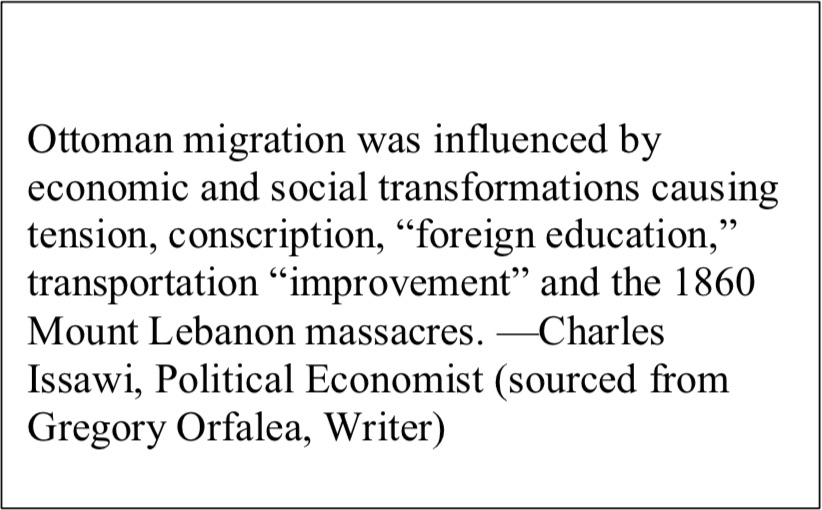

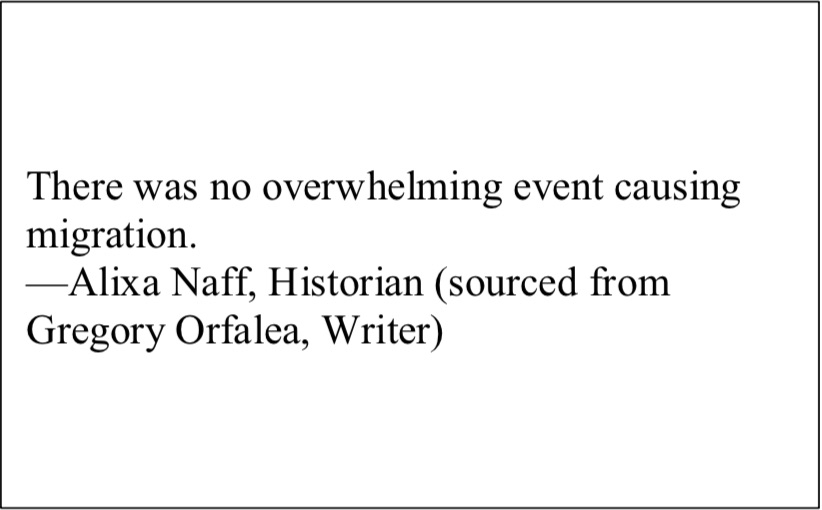
There is no singular consensus by historians, writers or political economists about the cause of late nineteenth century Ottoman migration. However, several historians postulate that there were multiple causes contributing to migration. Some immigrated, settling together, building neighborhoods and communities, while other migrants struck out on their own, or returned to the Ottoman Empire. In the “Immigrants in America” post, more information and a video about Syrian American communities can be found.
Conclusion
Heightened migration from the Ottoman Empire continued until the First World War, when the U.S. introduced strict immigration quotas and the Empire ceased to exist. It is difficult to pinpoint one specific reason why immigrants or emigrants left, because push and pull factors existed for both the Americas and as the Ottomans reformed. Whether because of agricultural plagues, military conscription, tax collectors, or religious warfare, Ottomans left the Empire in a First Wave, totalling about 100,000 people by the turn of the twentieth century (Orfalea). To delve into a deep understanding of the total history of the Empire, listen to the Ottoman History podcast. Episodes on Syrian Immigration, alongside reading academic articles on the subject, helped me see that the global movement of people, transnational identities and the perceived successes and failures of emigration is an ongoing, age-old development.
Understanding that the earliest Greater Syria individuals to the later ‘waves’ left the Empire for vast and complex reasons can help students of history situate Ottoman Greater Syrian migration in today’s global context of the refugee crisis. Migrants have come and left from and to the Middle East and Americas for a very long time, and according to historian Evelyn Shakir, “technology, democracy, education” attracted Ottomans, but “drowning them out, almost always, was the no-nonsense promise of American dollars.”
Works Cited
Bailony, Reem. “The Ottoman Empire in the Nineteenth Century.” History 207 A: The Global Middle East, 20 Sept. 2018, Agnes Scott College. Microsoft PowerPoint presentation.
Bailony, Reem. “The Rise of the World System.” History 207 A: The Global Middle East, 11 Sept. 2018, Agnes Scott College. Microsoft PowerPoint presentation.
Bailony, Reem. “Syrian Migrants: The Long View on Transatlantic Migration.” Center for Contemporary Arab Studies’ Newsmagazine, Fall/Winter 2017. (2017) pp. 6 sfs.georgetown.edu/syrian-migrants-long-view-transatlantic-migration. Accessed: 5 Dec. 2018.
Center for Middle Eastern Studies. Middle East in the 19th Century. 2018. The University of Chicago, https://cmes.uchicago.edu/page/maps.
Karpat, Kemal H. “The Ottoman Emigration to America, 1860–1914.” International Journal of Middle East Studies, vol. 17, no. 2, 1985, pp. 175-209.
Kayal, Philip M. “Religion and Assimilation: Catholic “Syrians” in America.” The International Migration Review, vol. 7, no. 4, 1973, pp. 409-425.
Khater, Akram F. and Antoine F. Khater. “Assaf: A Peasant of Mount Lebanon.” Struggle and Survival in the Modern Middle East, University of California Press, 1993, pp. 31-47.
Mysid. Flag of the Ottoman Empire (also used in Egypt). 2006. Wikipedia, https://en.wikipedia.org/wiki/File:Flag_of_the_Ottoman_Empire_(also_used_in_Egypt).svg.
Naar, Devin E. “Turkinos Beyond the Empire: Ottoman Jews in America, 1893 to 1924.” The Jewish Quarterly Review, vol. 105, no. 2, 2015, pp.174-205.
Orfalea, Gregory. The Arab Americans: A History. Interlink Publishing Group, Inc., 2006, pp. 1-107.
Shakir, Evelyn. “Part I: The First Wave, 1875-1925.” Bint Arab: Arab and Arab American Women in the United States. Praeger Publishers, 1997, pp. 13-51.
The Editors of Encyclopaedia Britannica. “Tanzimat.” Encyclopaedia Britannica, 4 Apr. 2016. www.britannica.com/event/Tanzimat. Accessed 11 Dec. 2018.
The Editors of Encyclopaedia Britannica. “The Empire from 1807 to 1920.” Encyclopaedia Britannica, 17 Nov. 2018. www.britannica.com/place/Ottoman-Empire/The-empire-from-1807-to-1920. Accessed 11 Dec. 2018.
Toledano, Ehud R. “Late Ottoman Concepts of Slavery (1830s-1880s).” Cultural Processes in Muslim and Arab Societies: Modern Period I, vol. 14, no. 3, 1993, pp. 477-506.